


Navigating the New Financial Landscape: Is Your Portfolio Aligned With Reality?
Stocks are hitting new highs on news of a potential U.S.–China trade agreement. Credit markets are calm. And yet, just weeks ago, headlines warned of looming corrections and cracks in the financial system. So what changed?
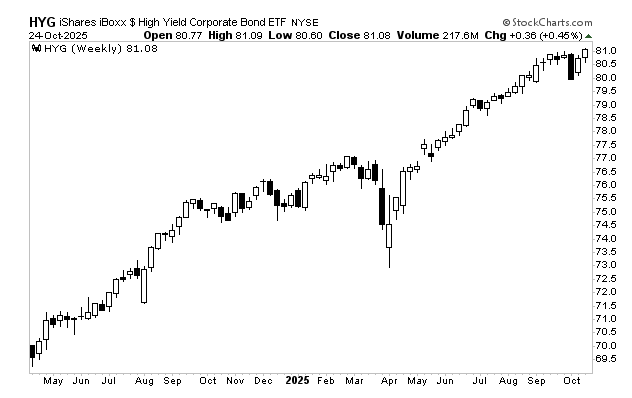
The rally isn’t just happening in equities — it’s being echoed in high-yield credit markets, which typically react faster to shifts in economic risk. High Yield Credit — often dubbed the “canary in the coal mine” for financial stress — is flashing no warning signs. The High Yield Credit ETF (HYG) has reached record highs, suggesting that systemic risk remains low.
There's nothing bearish about this chart. But this isn’t just about optimism. It’s about policy:
💸 The Great Global Melt-Up
We’re living through what some call the Great Global Melt-Up — a period where central banks are quietly choosing currency devaluation as their primary tool to manage debt and stimulate growth. With traditional options like austerity politically toxic and organic growth too slow, policymakers have turned every monetary spigot on full blast.
They claim we’ll “grow our way out of it,” meaning economic expansion will shrink the debt-to-GDP ratio over time. But the growth isn’t coming from productivity or innovation alone — it’s being manufactured through cheap money, rate cuts, and liquidity injections.
In the past 24 months, central banks have cut interest rates over 300 times — more than 13 cuts per month. This isn’t just stimulus. It’s a coordinated effort to make money so cheap that investors are forced into so-called "risk assets", driving up prices and inflating away debt.
💵 Strong Dollar Talk, Weak Dollar Reality
You’ll still hear officials talk about a “strong dollar policy.” But that’s mostly optics. In practice, the purchasing power of the dollar, the feature you rely on to purchase goods and services in retirement, is being reduced at an increased pace in order to keep the system afloat. While it may remain strong relative to other currencies, its purchasing power is quietly eroding — by design.
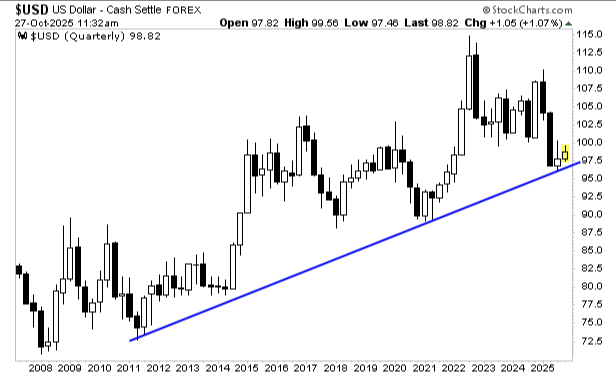
Take a look at the U.S. dollar and you’ll notice it’s approaching a key technical level — a 15-year trendline that’s now under pressure. If this level breaks, it could signal a meaningful shift in purchasing power. For investors holding significant wealth in cash or savings, it’s a reminder that capital preservation requires more than just staying liquid. That’s why investors are looking for assets that can grow — not just preserve — wealth.
This strategy isn’t new. After World War II, the U.S. faced similar debt levels and used a mix of low interest rates, inflation, and regulatory controls — known as "Financial Repression" — to reduce the real value of debt. Savers (often unknowingly) earned negative real returns while governments paid down obligations without defaulting or triggering hyperinflation.Some called this policy "a sheep shearing instruction manual", but overall, it worked for 35 years until the late 1970's. when it didn't (remember installing those wood stoves?)
Today’s version is faster, more global, and more digital. The tools are the same: ultra-low rates, quantitative easing, inflation tolerance, and nudges toward risk assets. Investors aren’t chasing fundamentals — they’re being pushed by policy, coordinated by central banks.
📈 What This Means for Investors
The game has changed — and the rules of the game aren’t printed on the box.
We’re in a financial environment shaped a little less by fundamentals and more by policy. Central banks are quietly rewriting the playbook: devalue the currency, suppress real yields, and push capital into risk assets. If you’re still playing by the old rules — hoarding cash, chasing yield, or trusting that savings alone will preserve wealth — you’re likely playing defense in a game that now rewards offense.
To survive, you need to understand the incentives. To thrive, you need to align with them.
In this environment, cash is not king. Investors need to think beyond traditional safe havens and position for assets that can outpace inflation and policy-driven devaluation.
That doesn’t mean abandoning stocks — it means being selective. The real opportunity lies in companies with:
Pricing power: Businesses that can raise prices without losing customers
Exposure to megatrends: AI, data infrastructure, robotics, decentralized finance (DeFi), and energy transformation
“Picks and shovels” positioning: Firms supplying the chips, software, energy systems, automation tools and raw materials (like silver, copper, lithium, uranium, gold) powering the next wave of innovation
These aren’t short-term trades — they’re foundational businesses with strong margins, recurring revenue, and global demand. They’re likely to benefit most from the liquidity flood central banks are unleashing.
🧠 Final Thoughts
The policy isn’t growth the way most people think of it. It’s devaluation disguised as growth. And if your portfolio isn’t aligned with that reality — if it’s sitting in cash, low-yield bonds, or legacy sectors — you may be on the wrong side of history.
Now’s the time to rethink what “safe” really means — and position for a world where growth is to a greater extent printed, not necessarily "earned".
While headlines focus on volatility, economic dislocations are quietly creating once-in-a-decade opportunities in income-producing assets as well.
REITs, business development companies, preferreds, and closed-end funds trading below their net asset values are offering compelling entry points — not just for yield, but for long-term portfolio diversification. These aren’t fringe investments. They’re time-tested businesses with real assets and real cash flow, temporarily mispriced by macro uncertainty, and we're watching them closely for optimal entry points.
There will be a time to add these to the mix — and that time may be closer than most realize.
The question is: Do you have a team on your side, working daily to help you identify and act on these opportunities?
Because this isn’t just a moment of disruption — it’s a moment of creative reinvention. Profit growth is accelerating, even as job replacement surges. Global money printing continues. And the rules of the game are shifting fast.
In times like these, strategy isn’t optional — it’s everything.
If you'd like to explore how working with us may be a great fit for you and your family, just reach out at Contact Maendel Wealth
*Please note that nothing here is to be considered individual financial advice. All investments and market prognostications involve some degree of risk and uncertainty. Alway consult a qualified, fiduciary financial advisor and financial planner before making any investment decisions.