


📊 The Everything Code + Bittel + Vissers: A New Investment Era?
“This time is different”is often a cautionary phrase—usually uttered right before things go wrong. But today, there are real structural markers suggesting that something truly new is unfolding. The signals aren’t just flashing—they’re rewiring the board. Liquidity is rising, technology is compounding, and the old playbook is breaking down.
Investors waiting for a crash may be missing the early stages of a transformation that doesn’t quite follow past cycles—the beginning of something much bigger.
Analysts Raoul Pal, Julien Bittel, and Jordi Visser each bring deep macro and market expertise, and while their paths differ, they share key traits that establish their credibility. Each of them brings a distinct lens and depth of research that’s helped sharpen my perspective and broadened my understanding of how to strategically build wealth in the years ahead. Let's explore a few of their key insights.
🧠 Raoul Pal’s “Everything Code”
Raoul Pal’s thesis is simple but profound: global liquidity drives everything. When central banks inject liquidity—through rate cuts, QE, or currency debasement—risk assets rise. His framework shows that:
We’re entering the Exponential Age, where AI, crypto, and digital platforms scale faster than anything before.
The business cycle is changing—less tied to traditional metrics, more driven by liquidity and tech adoption.
Crypto is the most asymmetric macro trade of our time, with adoption curves steeper than the internet’s.
📈 Julien Bittel's Insights
Bittel adds a layer of quantitative rigor to this thesis:
He tracks global liquidity flows, showing they’ve turned positive since April—fueling the rally in tech, crypto, and high-beta assets.
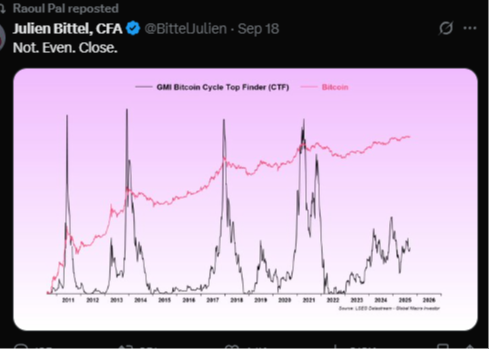
His models suggest we’re in a mid-cycle acceleration, not a late-cycle top. That means the crash many are waiting for may be years away.
He emphasizes momentum and positioning—and right now, the market is underexposed to the sectors driving growth.
🔍 Jordi Vissers' Perspective
Visser focuses on crypto-native signals and on-chain data:
He sees strong accumulation in Bitcoin and Ethereum wallets, suggesting smart money is buying dips.
He tracks miner behavior, staking flows, and treasury strategies—all pointing to long-term confidence.
He believes crypto is becoming infrastructure, not speculation—especially with moves like the U.S. Strategic Bitcoin Reserve.

🧭 Why This Cycle Is Different
Liquidity is back, but it’s flowing into new sectors: AI, crypto, energy, and infrastructure—not old-world value stocks.
Technology adoption is exponential, not linear. That means traditional valuation models break down.
Inflation is sticky, but central banks are pivoting toward growth. Waiting for a crash may mean missing the melt-up.
🛑 Sitting in Cash: The Hidden Risk
If you’ve been stuck on the sidelines in a money market fund earning <0.5%, you’ve already lost ground to inflation. That’s not safety—it’s erosion.
Instead, consider just a few examples of available alternatives that allow investors to take a modest step up the risk-reward curve. While these are not financial advice and, importantly, not FDIC insured, they represent examples of earning higher yield while maintaining high liquidity and stability.
| Option | Yield | Risk Profile | Why It’s Better |
|---|---|---|---|
| USFR (Floating Rate Treasury ETF) | ~5.4% | Very Low | Tracks short-term rates, adjusts with Fed policy |
| BIL (1–3 Month Treasury ETF) | ~5.2% | Very Low | Ultra-short duration, minimal volatility |
| TFLO (iShares Treasury Floating Rate) | ~5.3% | Very Low | Similar to USFR, optionfor parking cash |
These can be more effectivecash equivalents—earning real yield while staying liquid.
But to truly outpace inflation over time, you need exposure to select equities and assets with the potential for real growth. Anything less is just treading water—preserving purchasing power at best, while missing the compounding engine that builds lasting wealth.
As of mid-September 2025, there is approximately $7.28 trillion sitting in money market funds. This includes:
$2.96 trillion in retail funds(held by individual investors)
$4.32 trillion in institutional funds (held by corporations, pensions, etc.)
This massive cash pile reflects investor caution and the appeal of high short-term yields. But with inflation still elevated and the Federal Reserve signaling rate cuts ahead, that “wall of cash” may start moving into risk assets as yields decline.
🪜 How to Re-Enter the Market (Prudently)
You don’t need to go all-in. Considera laddered, incremental approach:
1️⃣ Start with a Realtively Stable Yield
Move idle cash into a well-researched money market alternative. With traditional cash holdings in many places paying under 0.5%, a move to near 5% may be the easiest “10X” you ever make.
While these are not financial advice and, importantly, not FDIC insured, they represent just a few examples of available alternatives that allow investors to take a modest step up the risk-reward curve—earning higher yield while maintaining liquidity and stability.
2️⃣ Consider Exposure to Asymmetric Sectors
These sectors offer the potential for real growth—the kind that can outpace inflation and compound wealth:
🔗 Blockchain Infrastructure & Crypto-Related ETFs
Digital assets are becoming infrastructure, not speculation. Treasury-backed accumulation and staking yield are reshaping how companies build value.
🧠 AI Infrastructure
Data centers, semiconductors, and energy producers are the backbone of the exponential economy.
Energy—not chips—is the real bottleneck of this new economy, according to Visser.
⛏️ Miners & DACs (Digital Asset Companies)
A new category of investment firms accumulating crypto treasuries and earning yield through staking and infrastructure.
🔍 Adjacent Sectors to Consider
These sectors stand to benefit alongside miners and AI infrastructure—forming a synergistic ecosystem of growth:
🧱 Industrial Metals & Materials
Why it matters: Data centers and electrification demand massive amounts of copper, aluminum, and rare earths. How to access: ETFs or funds focused on industrial metals, strategic materials, or global mining operations.
⚡ Power & Utilities Infrastructure
Why it matters: AI and crypto workloads are energy-intensive, driving demand for grid expansion and renewables. How to access: Funds targeting utilities, energy infrastructure, or clean energy transitions.
🏗️ Construction & Engineering
Why it matters: Specialized construction firms build the physical backbone of the digital economy. How to access: Infrastructure-focused ETFs or funds that include industrial construction and engineering firms.
🧠 Semiconductors & AI Hardware
Why it matters: Semiconductors are the brain of AI, powering exponential compute demand. How to access: Technology hardware ETFs that capture the broader AI supply chain.
🌐 Digital Infrastructure & REITs
Why it matters: Many data centers are owned by REITs specializing in digital infrastructure. How to access: REIT-focused funds that include data center operators and digital infrastructure providers.
3️⃣ Use Dollar-Cost Averaging
Weekly or monthly buys reduce timing risk and build exposure gradually.
4️⃣ Watch Liquidity Signals
Follow Bittel’s, Pal’s and other global liquidity models to understand bigger moves. Extensive research indicates that, especially since the Financial Crisis of 2008, Global Liquidity (Global M2) drives everything—and it’s rising.
🧠 Final Thought
This isn’t 2008. It’s not even 2022. We suspect that thenext five to ten years will likely be driven by abundance, not austerity—but only for those positioned in the right places.
Waiting for a "crash" might feel safe. But in this cycle, traditional notions of "safety" may bethe new risk, especially when seeking REAL returns, after inflation.

🧠 The Voices Reframing Risk and Opportunity
What They Have in Common
Global Macro DNA: All three are steeped in macroeconomic analysis, focused on liquidity, cycles, and structural shifts.
Institutional Experience: Each has worked at major financial institutions or hedge funds, managing large portfolios and advising elite clients.
Independent Voices: Today, they operate outside traditional finance—publishing research, building platforms, and advising investors directly.
Forward-Looking Frameworks: They’re not just reacting to markets—they’re shaping how people understand the next 5–10 years of investing.
📊 Individual Backgrounds
Raoul Pal
Ex-Goldman Sachs: Hedge fund sales in equities and derivatives
Ex-GLG Partners: Co-managed $500M global macro fund
Founder of Global Macro Investor (GMI) and Real Vision
Early crypto advocate: First macro valuation piece on Bitcoin in 2013
Julien Bittel
Ex-Pictet Asset Management: Co-managed CHF 5B multi-asset funds
Morningstar Award Winner
Head of Macro Research at GMI: Works closely with Pal on liquidity models
Jordi Visser
President & CIO of Weiss Multi-Strategy Advisers
Ex-Morgan Stanley: Head of global proprietary trading
Macro + Crypto Hybrid: Known for blending traditional macro with crypto-native insights
- Want to follow Global Liquidity as it heats up? You can explore the full chart and customize comparisons (e.g., against Bitcoin or Nasdaq) on or view the extended M2 index with offset functions on .
🌊 Think Beyond the Consensus of the Herd
As Visser, Pal, Bittel and other unconventional macro thinkers remind us: history doesn’t repeat, but it rhymes. And where it doesn’t rhyme—where the familiar pattern breaks—that’s often where the greatest opportunities for innovation and explosive growth emerge.
Thinking differently only works when you understand the underlying patterns and correlations.
Let’s uncover those patterns together, and explore specific investments that fit your unique goals, risk tolerance and financial planning objectives. Visit or reach out directly to start the conversation at jmaendel@e-vestech.com
*Please note that nothing here is to be considered individual financial advice. All investments and market prognostications involve some degree of risk and uncertainty. Alway consult a qualified, fiduciary financial advisor and financial planner before making any investment decisions.
