


📡 Physics Meets Psychology: Mapping the Environmental Triggers of Investor Behavior
Most people think behavioral finance began with Kahneman and Tversky. I started earlier—trading internet stocks in the early 2000s using ion count overlays and fractal sentiment maps from a subscription service called Super Force, run by Canadian inventor Guy Cramer. Yes, the same Guy whose grandfather invented the WWII walkie-talkie and who now builds invisibility camouflage for military forces.
Back then, Super Force wasn’t just a newsletter—it was a speculative fusion of atmospheric data, human behavior modeling, and market momentum forecasting. We tracked ionization spikes, mapped them to investor alertness, and traded tech stocks accordingly. It was fringe, unorthodox, and wildly ahead of its time. I even conversed with Guy regularly, exchanging ideas and insights as he refined his algorithms and explored new behavioral overlays. Around 2002, Guy was reportedly asked to stop publishing ion counts—just as the U.S. military began deploying Moon bounce ELF radar to image deep caverns in Afghanistan. Coincidence? Maybe. But it marked a turning point.
Around the same time, I was also having fascinating conversations with Arch Crawford, another pioneer who blended technical analysis with solar cycles and planetary rhythms using hard data. Arch began his career in the early 1960s at Merrill Lynch, where he trained under legendary technician Robert Farrell. He was so effective at predicting market movements that Merrill reportedly let him run a full trading team from a back room—quietly, to avoid reputational risk—because his methods included what he called “astrobiology” or “astro-finance.”
In 1977, Arch launched his own newsletter, Crawford Perspectives, after extensive research into astrophysical phenomena and their correlation to market performance. His work wasn’t mystical—it was cyclical, data-driven, and grounded in pattern recognition. Like Guy, Arch was mapping the invisible forces that shape investor behavior long before behavioral finance had a name.
Fast forward two decades: I now build risk-managed ETF portfolios, model volatility overlays, and design bias-to-behavior maps for investor psychology. The tools have changed, but the core remains—understanding how humans react under pressure, novelty, and uncertainty, and turning that into actionable insight.
Behavioral finance isn’t just about cognitive biases. It’s about mapping the invisible, whether that’s sentiment decay in new fund launches or the psychological impact of market structure on client decision-making. I’ve applied these principles to everything from retirement glidepath design to tax-aware rebalancing strategies—always with an eye toward clarity, modularity, and resonance.
🔬 Ion Ratios & Market Psychology: A Forgotten Frontier
We are surrounded by air that contains both positive and negative ions. Breathing in different ratios affects animals, insects, fish, and people—physically and mentally.
The full moon increases positive ion ratios, which correlates with the strange and aggressive behavior often reported by police and medical services.
Studies show that 75% of the population is adversely affected by elevated positive ion levels, while negative ions tend to have a calming influence.
Cramer developed a proprietary ion ratio algorithm focused on forecasting these shifts months in advance.
Their research suggested that positive ion ratios often coincide with rising stock markets (driven by irrational exuberance), while negative ion ratios align with market caution and declines.
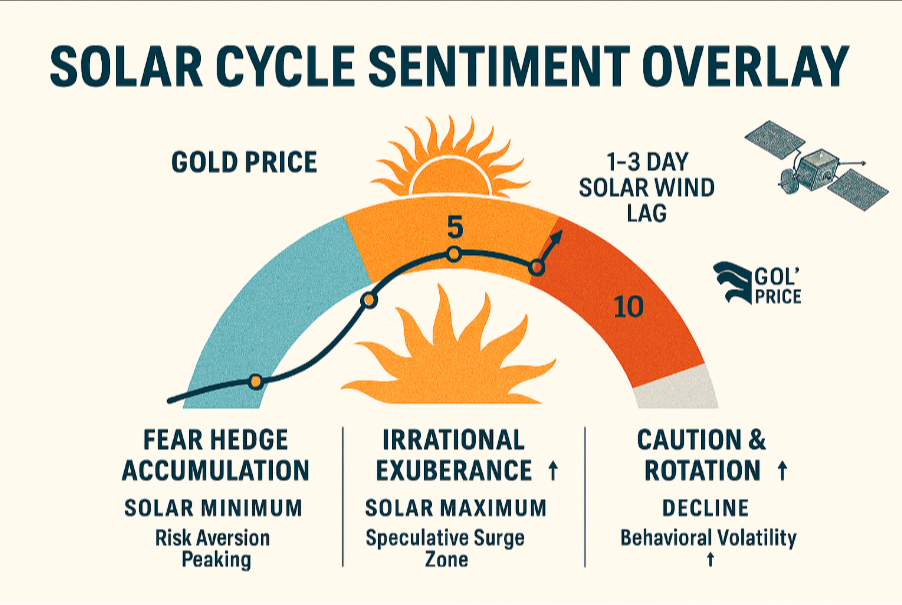
These forecasts were informed in part by data from ion-monitoring satellites positioned far beyond Earth—often near the L1 Lagrange Point, nearly a million miles out. Because solar wind and charged particles take 1–3 days to reach Earth, this created a predictive window: a lag between detection and impact that could be used to anticipate shifts in investor sentiment and market behavior.
In short: positive ions fuel greed, negative ions foster prudence—a behavioral overlay that still echoes in today’s volatility cycles.
☀️ Solar Cycles & Gold Price Correlation: A Rational Lens
Recent studies have shown a compelling correlation between solar activity cycles and gold price movements. Using data from 1970 to 2024, researchers found that the ordinal position within a solar cycle—tracked via sunspot numbers—correlates strongly with percentage changes in gold prices. In some phases, correlation coefficients reached as high as ±0.95.
Why might this work? It’s not about astrology—it’s about solar physics and human behavior. Solar maximums are associated with increased geomagnetic disturbance, which has been shown to affect everything from mood and sleep patterns to risk tolerance and decision-making. Gold, as a fear hedge, tends to surge when uncertainty rises—and solar peaks often coincide with periods of heightened geopolitical tension, inflationary pressure, and market volatility.
In other words, solar cycles may act as a proxy for ambient stress levels in the global system. Investors don’t respond to sunspots—they respond to the ripple effects those cycles have on sentiment, stability, and perceived risk.
Thinking outside the box isn’t a style—it’s a system. It’s a habit: looking past the obvious, questioning the structure, and building clarity where others see noise. It’s the kind of thinking that helps clients navigate uncertainty with confidence and clarity.
That’s exactly what our team does. We bring strategic insight, behavioral nuance, and modular planning to every portfolio and financial decision—translating complexity into clarity, and volatility into opportunity. Whether it’s designing tax-aware retirement strategies or decoding market sentiment around new ETF launches, we build frameworks that resonate, adapt, and deliver.
🌊 Think Beyond the Trendline
Markets don’t just move—they pulse. Investor behavior follows rhythms of optimism, fear, and recalibration. The real edge comes from recognizing those cycles early and building strategies that adapt, not react.
Because thinking outside the box only works when you know where the edges are. Let’s connect: or reach out directly to start the conversation at jmaendel@e-vestech.com
*Please note that nothing here is to be considered individual financial advice, and, to the best of my knowledge, neither publication mentioned is currently available.