


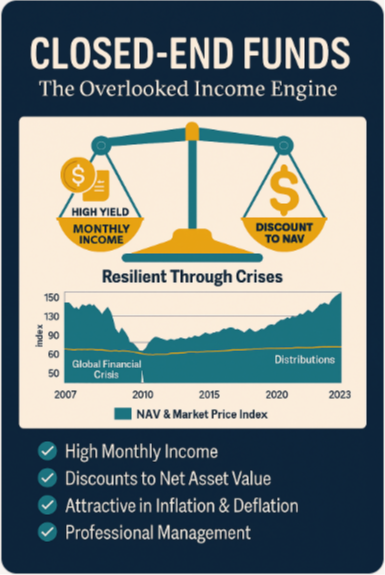
Most investors chase stocks or settle for money markets. Yet Closed‑End Funds (CEFs) quietly offer some of the most compelling opportunities in today’s income universe — high monthly yields, discounts to NAV, and potential upside across multiple scenarios.
What Makes CEFs Different
High yields: Many pay 7–9% (or more) annually, often monthly — far above investment‑grade bonds or money markets.
Discounts to NAV: Shares often trade below the value of their underlying assets. If sentiment improves, discounts narrow, adding capital gains on top of income.
Professional management: Quality CEFs are run by seasoned teams who actively manage leverage, sector exposure, and distribution policies.
Resilience across scenarios:
Inflation: Equity‑income CEFs benefit from dividend growth and real‑asset exposure.
Deflation: Bond‑heavy CEFs thrive as borrowing costs fall and NAVs rise.
Stable rates: Income remains high, discounts can narrow.
Why They’re Potentially even Better Deals Now
Liquidity backstops: Post‑2008 reforms and Fed facilities make systemic liquidity freezes less likely.
Relative yield advantage: Money markets match yields today (~5%), but collapse if rates fall. CEFs lock in 7–9% and could increase payouts if borrowing costs drop.
Ignored sectors: Funds focused on utilities, healthcare, or global credit are trading at wider discounts because they’ve been out of favor. With demographics, infrastructure spending, and the “new economy” as tailwinds, these sectors are poised for a reset.
The Risk to Remember
CEF investors must respect the power — and risk — of leverage. In systemic shocks like 2008 or COVID, discounts to NAV widened dramatically and fund values fell sharply. But today’s policy toolkit and the political willingness to intervene have reduced the odds of a catastrophic liquidity freeze. Volatility remains, yet the tail risk has been meaningfully muted.
Importantly, most quality funds recovered well and continued paying dividends — providing steady income for retirees and allowing growth‑oriented investors to reinvest and compound shares during downturns. Some funds use internal leverage, others do not — and that distinction matters. Careful analysis of leverage structures and management discipline is essential to separating resilient CEFs from fragile ones.
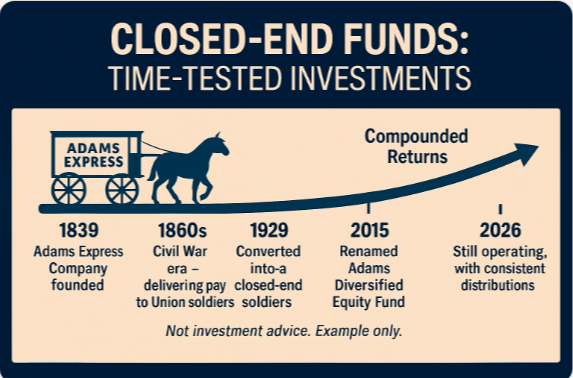
In short, a well‑chosen CEF can be an additional horse pulling your investment wagon — or another durable egg in your income basket, helping you navigate both calm and stormy markets with confidence.
Beyond Discounts: The Z‑Score
It’s tempting to stop at “is it trading at a discount?” But seasoned investors know that’s only half the story. Some funds always trade at a discount, so the real question is whether today’s discount is wider than usual. That’s where the Z‑Score comes in — a powerful tool to spot unusually cheap entry points. 👉 Read more in our earlier post: Buying Dollars for 90 Cents: Why CEFs Shine in a Market Reset.
Ready to Explore?
If you’re looking for high monthly income, discounted entry points, and upside across inflation, deflation, and policy cycles, quality CEFs deserve a closer look — whether as another egg in your income basket or an additional horse pulling your investment wagon toward long-term resilience.
👉 Need help identifying the most compelling CEF bargains while avoiding the pitfalls? Reach out to our team via the “Contact Us” box on our website, or email James Maendel directly at jmaendel@e-vestech.com. Let’s build an income strategy that thrives across scenarios — and pays you while you wait.